
Supercomputing and Scientific Computing
Machine translation. View original in Spanish
CSIC research staff have access to a much broader computing resource ecosystem than is commonly known: from CSIC’s own DRAGO supercomputer to some of Europe’s most powerful systems, and industry technology credit programs. This guide organizes them into seven layers, from the most accessible resource to the most powerful and complex. It is based on the Guide to computing systems available for scientific research at CSIC, prepared by the Scientific Computing Area (AIC) of the SGAI, June 2026 version.
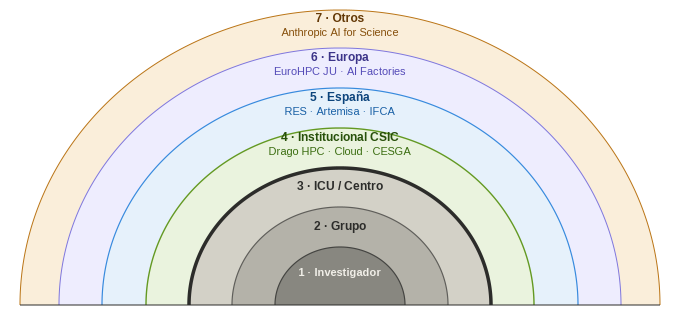
The seven layers
Layers 1 to 3 (your equipment, your group’s servers, and your institute’s clusters) depend on each case and are outside the scope of this guide. The other four are:
- Layer 4. CSIC Institutional: DRAGO HPC, DRAGO Cloud, and CESGA. Registration is done via a form, without a competitive call.
- Layer 5. Spain: the Spanish Supercomputing Network (RES), Artemisa (IFIC), and IFCA. These are free, with scientific evaluation.
- Layer 6. Europe: EuroHPC, with access to MareNostrum 5, LUMI, Leonardo, or JUPITER, and the AI Factories.
- Layer 7. Others: credit programs from Anthropic, OpenAI, Google Cloud, Microsoft, AWS, and NVIDIA.
How to choose
The recommended path is from the inside out: start with DRAGO HPC, move to the RES or Artemisa when CSIC resources are insufficient, explore EuroHPC when the project has European ambition, and complement at any time with industry credits. The experience and results from one layer strengthen proposals for the next.
- First steps in intensive computing: DRAGO HPC.
- Training medium-scale AI models: DRAGO HPC, with H200 and A100 GPUs.
- Continuous inference service: DRAGO Cloud.
- Specialized AI GPU with a central machine learning component: Artemisa.
- Large-scale CPU or GPU, with competitive free access: RES.
- Exploring European supercomputers: EuroHPC Benchmark or Development Access.
- Scientific AI at European scale: EuroHPC AI for Science.
- Urgent GPU access of up to 50,000 hours: EuroHPC Fast Lane.
- Access to language models for analyzing scientific texts: industry API programs.
Getting started with DRAGO
DRAGO is CSIC’s central supercomputer, operated by the AIC. It is free for scientific staff, with no competitive call and support in Spanish. To request registration, fill out the form on the AIC portal. Technical documentation is available on the documentation portal. For questions, write to sistemas-calculo@csic.es (Computing Systems Unit) or aic@sgai.csic.es.
Why now
In 2027–2028, European AI Gigafactories will arrive, for which Spain has submitted a bid. Groups arriving with active projects in EuroHPC will be better positioned. Meanwhile, more than half of the institutes do not have their own high-performance computing resources, and some of them still do not take advantage of DRAGO. The scarcest resource is not computing power: it is knowing it exists and daring to request it.
Programs and calls change rapidly. This guide is a starting point, and it is advisable to always confirm data with the official source of each resource before applying.
Layer 4: CSIC resources
DRAGO HPC, DRAGO Cloud and CESGA: the computing resources managed by CSIC, with direct access.
Layer 5: national resources
Spanish Supercomputing Network, Artemisa (IFIC) and IFCA: free access with scientific evaluation.
Layer 6: European resources
EuroHPC, its access modes and the AI Factories: Europe's most powerful supercomputers.
Layer 7: Industry programs
AI and cloud credits from technology companies for scientific research.